Best Graphics Card for 1080p (2026)

We earn a commission when you buy through our links, at no extra cost to you. As an Amazon Associate I earn from qualifying purchases.
Quick answer
You want smooth 1080p play with room for higher resolutions, so choose the ASRock Radeon RX 7700 XT Challenger 12GB OC Graphics Card: its 12GB of GDDR6 memory on a 192-bit bus and 2584 MHz boost clock suit demanding titles at 1080p. The RX 7600 Challenger Pro answers with a 2695 MHz boost clock, triple fans, and a 3-year warranty, while the RTX 3050 pairs 6GB of GDDR6 with a 3-year warranty.
Ranked at a glance
| # | Product | VRAM | Boost clock | WiseScore | Link |
|---|---|---|---|---|---|
| 1 | 12 GB | 2.58 GHz | 9.8/10 | Check on Amazon → | |
| 2 |  ASRock Radeon RX 7600 Challenger Pro 8GBSecond Pick | 8 GB | 2.69 GHz | 9.5/10 | Check on Amazon → |
| 3 | 8 GB | — | 9.2/10 | Check on Amazon → | |
| 4 |  msi Gaming GeForce RTX 3050Also Consider | 6 GB | 1.51 GHz | 9.1/10 | Check on Amazon → |

The lineup, one by one

ASRock Radeon RX 7700 XT Challenger 12GB OC Graphics Card
The 12GB of GDDR6 memory on a 192-bit bus and the 2584 MHz boost clock define this card for 1080p play and higher resolutions.
Why #1: Top figure in this lineup for vRAM (12 GB). The rest of its WiseScore comes from Amazon sales data.
- VRAM
- 12 GB
- Boost clock
- 2.58 GHz
- Warranty
- 1 year
Good fit if
- You play demanding titles at 1080p and want 12GB of GDDR6 memory
- You run 3 DisplayPort 2.1 monitors and 1 HDMI 2.1 display
Look elsewhere if
- You need the 2695 MHz boost clock of the RX 7600 Challenger Pro
- You need the 3-year warranty of the RX 7600 Challenger Pro
This card carries 12GB of GDDR6 memory on a 192-bit bus with 48MB of AMD Infinity Cache, 54 compute units, a 2584 MHz boost clock and a 2226 MHz game clock. Cooling comes from a dual-fan design with striped ring fans and ultra-fit heatpipes, and the fans stay off at low temperatures for silent operation during light workloads. A metal backplate adds structural rigidity. Outputs are 3 DisplayPort 2.1 ports and 1 HDMI 2.1 port. Power runs through dual 8-pin connectors on a PCIe 4.0 interface. The warranty runs 1 year. Check power supply, chassis space and motherboard specifications before ordering, since the card is not compatible with all pre-built systems.
ASRock Radeon RX 7600 Challenger Pro 8GB
The 2695 MHz boost clock, 8GB of GDDR6 memory and triple-fan cooling define this card for 1080p and 1440p play.
Why #2: Top figure in this lineup for boost clock (2.69 GHz). The rest of its WiseScore comes from Amazon sales data.
- VRAM
- 8 GB
- Boost clock
- 2.69 GHz
- Warranty
- 3 Years
Good fit if
- You want a 2695 MHz boost clock with 8GB of GDDR6 memory
- You want four displays at resolutions up to 8K
Look elsewhere if
- You need the 12GB of GDDR6 memory of the RX 7700 XT
- You need the 192-bit memory bus of the RX 7700 XT
This card pairs 8GB of GDDR6 memory on a 128-bit interface at 18 Gbps with 32MB of AMD Infinity Cache, 32 RDNA 3 compute units, 2048 stream processors, a 2695 MHz boost clock and a 2280 MHz game clock. The triple-fan Challenger Pro cooling system uses striped axial fans and ultra-fit heatpipes, and 0dB silent cooling stops the fans at low temperatures. The card measures 303 mm by 131 mm by 45 mm in a 2.5-slot design, takes a single 8-pin power connector and names a 550W recommended power supply. Outputs are 3 DisplayPort 1.4a ports with DSC and 1 HDMI 2.1 port. The warranty runs 3 years.
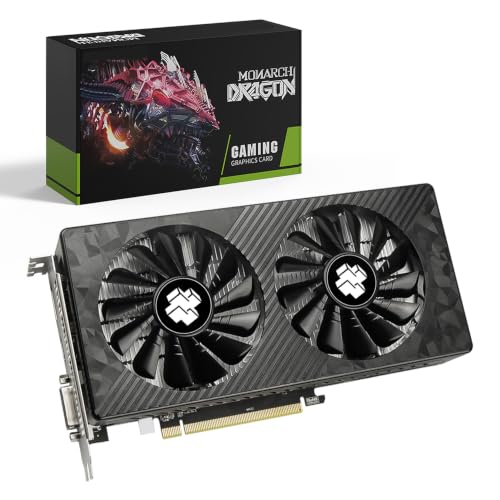
MOUGOL AMD Radeon RX 580 8GB GDDR5 Gaming Graphics Card
The 8GB of GDDR5 memory on a 256-bit bus and the 1206 MHz core clock define this compact card for entry-level 1080p play.
Why #3: No single top figure here; its WiseScore comes from its overall specs plus Amazon sales data.
- VRAM
- 8 GB
- Warranty
- 1 Year
Good fit if
- You want 8GB of GDDR5 memory on a 256-bit bus
- You want a 240 mm card for a compact desktop build
Look elsewhere if
- You need the 12GB of GDDR6 memory of the RX 7700 XT
- You need the 2695 MHz boost clock of the RX 7600 Challenger Pro
This card carries 8GB of GDDR5 memory on a 256-bit interface with 2048 stream processors and a 1206 MHz core clock. The dual-fan cooling system uses high-efficiency heat pipes, and intelligent fan control keeps the fans quiet during light office work. The card measures 240 by 135 by 45 mm and fits standard ATX mid-towers and micro-ATX cases. Outputs are HDMI, DisplayPort and DVI for triple-monitor setups. It supports DirectX 12, Vulkan and OpenGL 4.6, with hardware acceleration for video editing and 3D rendering. The warranty runs 1 year.
msi Gaming GeForce RTX 3050
The 6GB of GDDR6 memory at 14 Gbps and the 1507 MHz boost clock define this card for 1080p play on a smaller memory bus.
Why #4: No single top figure here; its WiseScore comes from its overall specs plus Amazon sales data.
- VRAM
- 6 GB
- Boost clock
- 1.51 GHz
- Warranty
- 3 Years
Good fit if
- You want 6GB of GDDR6 memory at 14 Gbps
- You want 2 HDMI 2.1a ports and 1 DisplayPort 1.4a
Look elsewhere if
- You need the 8GB of GDDR6 memory of the RX 7600 Challenger Pro
- You need the 256-bit memory bus of the RX 580
This card carries 6GB of GDDR6 memory at 14 Gbps on a 96-bit memory interface, with a 1507 MHz boost clock and Ampere architecture. Outputs are 1 DisplayPort 1.4a port and 2 HDMI 2.1a ports. The card measures 1.7 by 4.3 by 8.1 inches. The warranty runs 3 years. The chipset is the GeForce RTX 3050, and the card is the GAMING X 6G model with a black finish.
Worth the splurge, and what you can skip
Worth the splurge
- 12GB of GDDR6 memory. The RX 7700 XT Challenger is the pick with 12GB of GDDR6 memory, so choose it when your games need 12GB rather than 8GB or 6GB.
- A 2695 MHz boost clock. The RX 7600 Challenger Pro is the pick with the 2695 MHz boost clock, so choose it when your games need 2695 MHz rather than 2584 MHz.
Fine to skip
- Triple-fan cooling. A buyer with a compact case fits the 240 mm RX 580, and its dual-fan cooling already covers that build, so the triple-fan design of the RX 7600 Challenger Pro is not called for.
- A 3-year warranty. If 1 year of coverage meets your need, the RX 7700 XT Challenger and the RX 580 each carry a 1-year warranty, so the 3-year term of the RX 7600 and the RTX 3050 is not called for.
Deciding factors for graphics cards
Memory size and bus width
Memory size and bus width set how much texture data a card holds and how fast it moves. The RX 7700 XT Challenger carries 12GB of GDDR6 memory on a 192-bit bus with 48MB of AMD Infinity Cache. The RX 7600 Challenger Pro carries 8GB of GDDR6 on a 128-bit interface at 18 Gbps, rated up to 288 GB/s of bandwidth, with 32MB of Infinity Cache. The RX 580 carries 8GB of GDDR5 on a 256-bit bus, while the RTX 3050 carries 6GB of GDDR6 on a 96-bit interface at 14 Gbps. The RX 7700 XT Challenger pairs its 12GB of GDDR6 with 48MB of AMD Infinity Cache.
Boost clock and compute units
Clock speed and compute units describe the processing figures behind each card. The RX 7700 XT Challenger runs a 2584 MHz boost clock and a 2226 MHz game clock with 54 compute units. The RX 7600 Challenger Pro runs a 2695 MHz boost clock and a 2280 MHz game clock with 32 RDNA 3 compute units and 2048 stream processors. The RX 580 runs a 1206 MHz core clock with 2048 stream processors, and the RTX 3050 runs a 1507 MHz boost clock. A higher boost clock figure does not by itself set the frame rate of a game, so read it beside the memory figures and the resolution you play at. The boost clocks here are 2584 MHz, 2695 MHz and 1507 MHz, while the RX 580 core clock is 1206 MHz.
Outputs, size and power
Outputs, size and power decide whether a card fits your monitor setup, your case and your power supply. The RX 7700 XT Challenger gives 3 DisplayPort 2.1 ports and 1 HDMI 2.1 port, with dual 8-pin power connectors. The RX 7600 Challenger Pro gives 3 DisplayPort 1.4a ports with DSC and 1 HDMI 2.1 port, measures 303 mm by 131 mm by 45 mm in a 2.5-slot design, and takes a single 8-pin connector with a 550W recommended power supply. The RX 580 gives HDMI, DisplayPort and DVI outputs in a 240 by 135 by 45 mm card. The RTX 3050 gives 1 DisplayPort 1.4a port and 2 HDMI 2.1a ports in a 1.7 by 4.3 by 8.1 inch card.
FAQ about graphics cards
How much VRAM do I need for 1080p gaming?
The picks carry 12GB, 8GB, 8GB and 6GB of video memory. The RX 7700 XT Challenger carries 12GB of GDDR6, the RX 7600 Challenger Pro and the RX 580 carry 8GB each, and the RTX 3050 carries 6GB of GDDR6. Compare those figures against the games you play.
How many displays can these graphics cards run?
The RX 7700 XT Challenger gives 3 DisplayPort 2.1 ports and 1 HDMI 2.1 port. The RX 7600 Challenger Pro supports up to four displays at resolutions up to 8K. The RX 580 supports triple-monitor setups, and the RTX 3050 gives 1 DisplayPort 1.4a port and 2 HDMI 2.1a ports.
How long is the warranty on these graphics cards?
The RX 7700 XT Challenger carries a 1-year warranty, and the RX 580 carries a 1-year warranty. The RX 7600 Challenger Pro carries a 3-year warranty, and the RTX 3050 carries a 3-year warranty. Compare the warranty term with the card figures before ordering.
Bottom line
Compare before you buy
Side-by-side comparisons that include graphics cards, checked with the same spec data.
Keep comparing
More computers & office guides, ranked with the same WiseScore method.

Written by Nathan Reeve, WiseSplurge editor
Specs come from each maker's Amazon listing and were last checked on November 29, 2026. Each WiseScore (out of 10) blends those specs with Amazon sales data. We compare published figures rather than testing products in person.