Best Telescope for Deep Space (2026)

We earn a commission when you buy through our links, at no extra cost to you. As an Amazon Associate I earn from qualifying purchases.
Quick answer
A 150 mm aperture gathers the most light here, so choose the MEEZAA Telescope if you want the brightest deep space views in this lineup. Its 650 mm focal length and equatorial mount track the Moon, planets and stars, and its 26X to 130X magnification covers the Moon, planets and deep space. The Gskyer 130EQ has a maximum magnification of 307X for closer views of planets.
Ranked at a glance
| # | Product | Aperture | Focal length | WiseScore | Link |
|---|---|---|---|---|---|
| 1 | 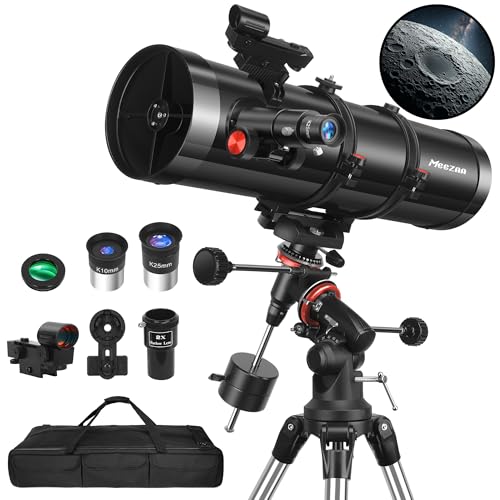 MEEZAA TelescopeBest Overall | 150 mm | 650 mm | 9.6/10 | Check on Amazon → |
| 2 | 130 mm | 650 mm | 9.5/10 | Check on Amazon → | |
| 3 | 130 mm | — | 9.4/10 | Check on Amazon → | |
| 4 | 114 mm | — | 9.3/10 | Check on Amazon → | |
| 5 |  SVBONY SV550 Triplet APO TelescopeAlso Consider | 122 mm | 854 mm | 9.2/10 | Check on Amazon → |

The lineup, one by one
MEEZAA Telescope
A 150 mm reflector with a 650 mm focal length, an equatorial mount and 26X to 130X magnification for deep space, planets and the Moon.
Why #1: Top figure in this lineup for aperture (150 mm). The rest of its WiseScore comes from Amazon sales data.
- Aperture
- 150 mm
- Focal length
- 650 mm
- Mount
- equatorial
Good fit if
- You want a 150 mm aperture for deep space
- You want an equatorial mount with slow-motion tracking controls
Look elsewhere if
- You need 307X maximum magnification like the Gskyer 130EQ
- You need an 854 mm focal length like the SVBONY SV550
The MEEZAA Telescope pairs a 150 mm aperture with a 650 mm focal length for deep space observation, planets and the Moon. Two eyepieces at 25 mm and 10 mm plus a 2X Barlow lens give magnification from 26X to 130X, and the red dot finderscope aims the tube while the moon filter cuts glare. The German equatorial mount uses precision dials and slow-motion control knobs for manual tracking. A stainless steel tripod with an accessory tray holds the tube steady, and every part fits into the carry bag. A phone adapter, moon filter and carry bag come in the box. Setup needs no tools.
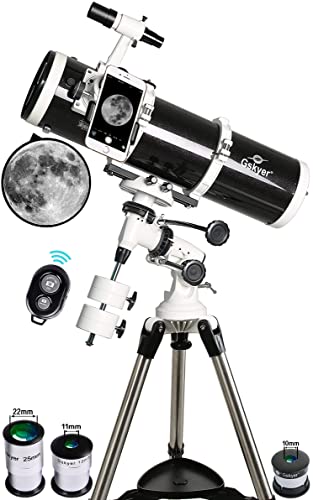
Gskyer 130EQ Professional Astronomical Reflector Telescope
A 130 mm reflector with a 650 mm focal length, a German equatorial mount and 307X maximum magnification for the Moon, planets and deep sky objects.
Why #2: No single top figure here; its WiseScore comes from its overall specs plus Amazon sales data.
- Aperture
- 130 mm
- Focal length
- 650 mm
- Mount
- equatorial
- Warranty
- 1-year
Good fit if
- You want 307X maximum magnification for lunar craters and planets
- You want a Bluetooth camera remote for photos and videos
Look elsewhere if
- You need a 150 mm aperture like the MEEZAA Telescope
- You need a 2-year warranty like the Celestron DX 130AZ
The Gskyer 130EQ pairs a 130 mm aperture with a 650 mm focal length at f/5, and its all-glass optics carry high transmission coatings. Three eyepieces and a 3X Barlow lens feed a maximum magnification of 307X, and the 24-inch tube keeps the setup compact. The German equatorial mount tracks celestial objects across the night sky, and the toothless focusing base suits beginners and advanced astronomers. A Bluetooth camera remote pairs with iPhone or Android devices for photos and videos. The purchase includes a 1-year warranty and lifetime maintenance.

Celestron StarSense Explorer DX 130AZ Smartphone Guided Newtonian Telescope
A 130 mm Newtonian reflector with smartphone sky navigation, a manual altazimuth mount and a 2-year warranty for guided backyard astronomy.
Why #3: No single top figure here; its WiseScore comes from its overall specs plus Amazon sales data.
- Aperture
- 130 mm
- Mount
- altazimuth
- Warranty
- 2-Year
Good fit if
- You want phone-guided navigation to stars, planets and nebulae
- You want a 130 mm reflector with a 2-year warranty
Look elsewhere if
- You need a 150 mm aperture like the MEEZAA Telescope
- You need an equatorial mount like the Gskyer 130EQ
The Celestron StarSense Explorer DX 130AZ docks a phone and runs the StarSense Explorer app, which reads star patterns overhead to point the telescope. The app shows the top objects for the time and location, and on-screen arrows guide the tube until the bullseye turns green. The 130 mm Newtonian reflector carries high-reflectivity coatings for views of the Moon, Jupiter, Saturn, the Orion Nebula and the Andromeda Galaxy. A manual altazimuth mount with dual-axis slow-motion controls tracks the target. The purchase includes a 2-year US warranty and support from US-based experts.
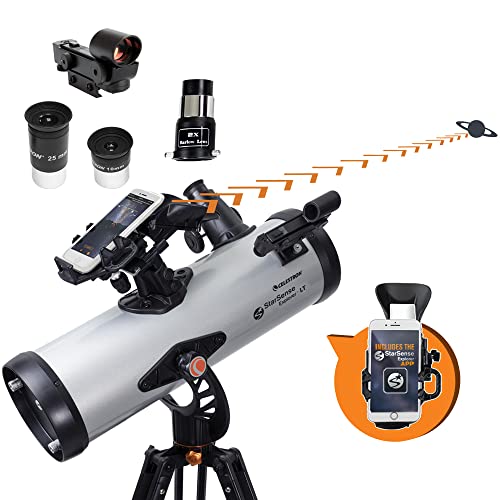
Celestron StarSense Explorer LT 114AZ Newtonian Smartphone Guided Telescope
A 114 mm Newtonian reflector with smartphone sky navigation, a manual altazimuth mount and a 2-year warranty for guided beginner viewing.
Why #4: No single top figure here; its WiseScore comes from its overall specs plus Amazon sales data.
- Aperture
- 114 mm
- Mount
- altazimuth
- Warranty
- 2-Year
Good fit if
- You want phone-guided navigation in a portable beginner telescope
- You want a 114 mm reflector with a 2-year warranty
Look elsewhere if
- You need a 130 mm aperture like the Gskyer 130EQ
- You need an equatorial mount like the MEEZAA Telescope
The Celestron StarSense Explorer LT 114AZ docks a phone and runs the StarSense Explorer app, which reads star patterns overhead to point the telescope. The app shows the top objects for the time and location, and on-screen arrows guide the tube until the bullseye turns green. The 114 mm Newtonian reflector carries high-reflectivity coatings for views of the Moon, Jupiter, Saturn, the Orion Nebula and the Andromeda Galaxy. A manual altazimuth mount with altitude slow motion adjustment and a sliding rod tracks the target. The 114 mm tube keeps the setup portable for beginners. The purchase includes a 2-year US warranty and support from US-based experts.
SVBONY SV550 Triplet APO Telescope
A 122 mm triplet APO refractor with an 854 mm focal length, a dual-speed focuser and a lifetime warranty for deep space astrophotography.
Why #5: Top figure in this lineup for focal length (854 mm). The rest of its WiseScore comes from Amazon sales data.
- Aperture
- 122 mm
- Focal length
- 854 mm
- Warranty
- lifetime
Good fit if
- You want an 854 mm focal length for deep sky photography
- You want ED glass that reduces chromatic aberration
Look elsewhere if
- You need a 130 mm aperture like the Gskyer 130EQ
- You need a fast f/5 focal ratio like the Gskyer 130EQ
The SVBONY SV550 pairs a 122 mm aperture with an 854 mm focal length at f/7 for deep sky photography and observation. Its FPL-51 triplet apochromatic lens holds one piece of ED glass, which reduces chromatic aberration for clearer, sharper images. The 2.5-inch dual-speed focuser runs at a 1:10 gear ratio with 87 mm of focus travel for fast and fine focusing. A 300 mm dovetail keeps the tube balanced during adjustment. The OTA weighs 6.44 kg, or 14.18 lb, and fits into a carrying case. The purchase includes a lifetime warranty for the telescope or OTA, with 30 days to return it.
Worth the splurge, and what you can skip
Worth the splurge
- A 150 mm aperture. The MEEZAA Telescope carries a 150 mm aperture, so choose it when your deep space viewing needs strong light gathering for faint objects.
- A dual-speed focuser. The SVBONY SV550 is the pick with a 2.5-inch dual-speed focuser at a 1:10 gear ratio, so choose it when your astrophotography needs fast and fine focusing.
Fine to skip
- Smartphone sky navigation. If you track objects by hand, the MEEZAA Telescope already tracks with an equatorial mount and slow-motion controls, and the Gskyer 130EQ already tracks with an equatorial mount, so app guidance adds a step you would not use.
- A 307X maximum magnification. If 130X magnification covers your viewing, the MEEZAA Telescope already offers magnification up to 130X, so the 307X maximum of the Gskyer 130EQ adds magnification you would not use.
Deciding factors for telescopes
Aperture and light gathering
Aperture runs from 114 mm on the Celestron LT 114AZ to 150 mm on the MEEZAA Telescope. The Gskyer 130EQ and the Celestron DX 130AZ each carry 130 mm, and the SVBONY SV550 carries 122 mm. The MEEZAA Telescope uses its 150 mm aperture for light-gathering power and bright, clear images of deep space, planets and the Moon. The Gskyer 130EQ uses its 130 mm aperture for brighter galaxies, nebulas and star clusters, and the SVBONY SV550 uses its 122 mm aperture for fainter deep sky objects through a higher limiting magnitude. The Celestron LT 114AZ carries a 114 mm aperture for Moon, planet and deep sky views.
Mounts and tracking
Mounts split between equatorial and altazimuth. The MEEZAA Telescope runs a German equatorial mount with slow-motion control knobs, and the Gskyer 130EQ runs a German equatorial mount. The Celestron DX 130AZ and LT 114AZ run manual altazimuth mounts with slow-motion controls, and the StarSense app guides the tube to the target. The Gskyer 130EQ adds a toothless focusing base, and the Celestron LT 114AZ adjusts altitude with a sliding rod. The MEEZAA Telescope adds precision dials to its equatorial mount, and the Gskyer 130EQ tracks celestial objects as they move across the night sky. The SVBONY SV550 is sold as a tube, with a 300 mm dovetail for balance during adjustment.
Magnification, focus and photography
Magnification runs from 26X to 130X on the MEEZAA Telescope, with two eyepieces at 25 mm and 10 mm and a 2X Barlow lens. The Gskyer 130EQ carries three eyepieces and a 3X Barlow lens for a maximum magnification of 307X. The SVBONY SV550 runs a 2.5-inch dual-speed focuser at a 1:10 gear ratio with 87 mm of focus travel for fast and fine focusing. The Gskyer 130EQ pairs with a Bluetooth camera remote for photos and videos on iPhone or Android devices. The MEEZAA Telescope includes a phone adapter and a moon filter. The Celestron DX 130AZ and LT 114AZ guide viewing through the StarSense app.
FAQ about telescopes
How much aperture do I need for deep space viewing?
The MEEZAA Telescope carries a 150 mm aperture, the Gskyer 130EQ and Celestron DX 130AZ carry 130 mm, the SVBONY SV550 carries 122 mm, and the Celestron LT 114AZ carries 114 mm. The SVBONY SV550 suits fainter deep sky objects through a higher limiting magnitude with its 122 mm aperture.
Which telescopes here use an equatorial mount?
The MEEZAA Telescope runs a German equatorial mount with slow-motion control knobs, and the Gskyer 130EQ runs a German equatorial mount. The Celestron DX 130AZ and LT 114AZ run manual altazimuth mounts, and the SVBONY SV550 is sold as a tube.
Which telescope here is best for astrophotography?
The SVBONY SV550 is built for deep space astrophotography with its 122 mm aperture, 854 mm focal length and dual-speed focuser. The Gskyer 130EQ adds a Bluetooth camera remote for photos and videos. The MEEZAA Telescope includes a phone adapter.
Bottom line
Compare before you buy
Side-by-side comparisons that include telescopes, checked with the same spec data.
Keep comparing
More cameras & optics guides, ranked with the same WiseScore method.

Written by Nathan Reeve, WiseSplurge editor
Specs come from each maker's Amazon listing and were last checked on November 29, 2026. Each WiseScore (out of 10) blends those specs with Amazon sales data. We compare published figures rather than testing products in person.