Explore Scientific vs Celestron Telescopes (2026)

We earn a commission when you buy through our links, at no extra cost to you. As an Amazon Associate I earn from qualifying purchases.
Quick answer
Explore Scientific fits buyers who want the largest aperture here, the 254 mm Dobsonian, or the lightest tube at 5.95 lb. Celestron fits buyers who want an equatorial mount with a 2-year warranty on every model, with apertures from 80 mm to 130 mm. Both sides offer an 80 mm refractor, the ED80 and the PowerSeeker 80EQ, so the choice turns on aperture, mount and weight.
Specs side by side
| Spec | Explore Scientific | Celestron |
|---|---|---|
| Aperture | 254 mm, 80 mm | 80 mm, 130 mm, 127 mm |
| Focal length | —, 480 mm | — |
Each cell lists the figure for every pick on that side, in the order shown below.
The picks on each side
Explore Scientific

- Aperture
- 254 mm
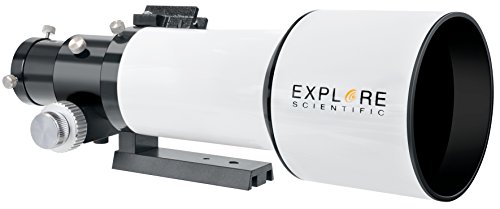
- Aperture
- 80 mm
- Focal length
- 480 mm
Celestron


Key differences
Aperture size
The Explore Scientific Dobsonian has a 254 mm aperture, the largest here, while the ED80 has an 80 mm aperture. The ED80 also gives a 480 mm focal length at f/6 for astrophotography. On the Celestron side, the PowerSeeker 80EQ has an 80 mm aperture, the PowerSeeker 127EQ has a 127 mm aperture, and the AstroMaster 130EQ-MD has a 130 mm aperture. Explore Scientific gives the largest aperture at 254 mm, while Celestron gives three apertures from 80 mm to 130 mm.
Mount type
The Explore Scientific Dobsonian uses a Dobsonian mount, and the ED80 comes as an optical tube. All three Celestron models use equatorial mounts: the PowerSeeker 80EQ and 127EQ use German Equatorial mounts, and the AstroMaster 130EQ-MD uses an equatorial mount with a motor drive for automatic tracking. The AstroMaster 130EQ-MD adds two slow-motion control knobs for right ascension and declination, and the PowerSeeker models add a slow-motion altitude rod. Celestron gives an equatorial mount on every model, while Explore Scientific gives a Dobsonian mount on its largest telescope.
Telescope weight
The Explore Scientific Dobsonian weighs 41.5 lb, the heaviest here, while the ED80 weighs 5.95 lb, the lightest here. On the Celestron side, the PowerSeeker 127EQ weighs 13 lb, the PowerSeeker 80EQ weighs 16.4 lb, and the AstroMaster 130EQ-MD weighs 17 lb. Celestron's three models cluster close together, from 13 lb to 17 lb, while Explore Scientific's two models sit at opposite ends of the range. Explore Scientific spans the widest weight range, while Celestron stays between 13 lb and 17 lb.
Which one to choose
Choose Explore Scientific if
- You want the 254 mm aperture of the Dobsonian
- You want the lightest tube here at 5.95 lb
- You want two Plossl eyepieces and a collimation tool
Choose Celestron if
- You want an equatorial mount on every model
- You want a 2-year warranty on every model
- You want motorized tracking on the AstroMaster 130EQ-MD
FAQ
Which brand has the largest aperture?
The Explore Scientific Dobsonian has a 254 mm aperture, the largest here. The largest Celestron aperture is the AstroMaster 130EQ-MD at 130 mm, followed by the PowerSeeker 127EQ at 127 mm. The ED80 matches the PowerSeeker 80EQ at 80 mm.
Which telescopes use an equatorial mount?
All three Celestron models use equatorial mounts: the PowerSeeker 80EQ, the PowerSeeker 127EQ and the AstroMaster 130EQ-MD. The Explore Scientific Dobsonian uses a Dobsonian mount instead. The ED80 comes as an optical tube.
Which telescope is the lightest here?
The Explore Scientific ED80 weighs 5.95 lb, the lightest here. The lightest Celestron is the PowerSeeker 127EQ at 13 lb, followed by the PowerSeeker 80EQ at 16.4 lb. The heaviest here is the Explore Scientific Dobsonian at 41.5 lb.
Bottom line
Buy Explore Scientific if you want the 254 mm aperture of the Dobsonian, the 5.95 lb ED80 tube, or the two Plossl eyepieces and collimation tool. The ED80 suits buyers who want a portable 80 mm tube for astrophotography. Buy Celestron if you want an equatorial mount with a 2-year warranty on every model, or motorized tracking on the AstroMaster 130EQ-MD.
Keep comparing

Written by Nathan Reeve, WiseSplurge editor
Specs come from each maker's Amazon listing and were last checked on November 29, 2026. Each WiseScore (out of 10) blends those specs with Amazon sales data. We compare published figures rather than testing products in person.