Best Digital Mixer (2026)

We earn a commission when you buy through our links, at no extra cost to you. As an Amazon Associate I earn from qualifying purchases.
Quick answer
The Behringer X AIR XR18 18-Channel is the pick for studio and live work, with 18 channels, 12 buses, and 16 programmable MIDAS preamps. It runs from an iPad or Android tablet over its built-in Tri-mode Wi-Fi router. The Yamaha DM3 Standard adds a 9-inch touch screen and 22 channels at 96kHz. The FLOW 8 brings 60 mm channel faders and Bluetooth app control. The CQ-18T adds a 7-inch touchscreen and a 24x22 USB interface.
Ranked at a glance
| # | Product | Channels | Buses | WiseScore | Link |
|---|---|---|---|---|---|
| 1 | 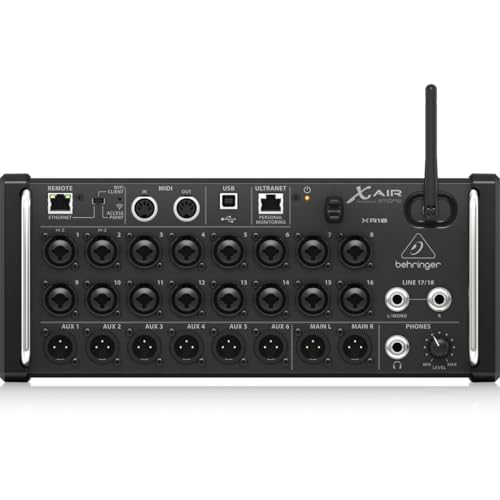 Behringer X AIR XR18 18-ChannelBest Overall | 18 ch | 12 buses | 9.7/10 | Check on Amazon → |
| 2 | 22 ch | — | 9.1/10 | Check on Amazon → | |
| 3 |  Behringer FLOW 8 8-Input Digital MixerAlso Consider | — | — | 9.0/10 | Check on Amazon → |
| 4 |  Allen & Heath CQ-18T Digital MixerAlso Consider | — | — | 8.9/10 | Check on Amazon → |
The lineup, one by one
Behringer X AIR XR18 18-Channel
The XR18 combines 18 channels, 12 buses, 16 programmable MIDAS preamps, and tablet control in one unit.
Why #1: No single top figure here; its WiseScore comes from its overall specs plus Amazon sales data.
- Channels
- 18 ch
- Buses
- 12 buses
Good fit if
- You mix 18 channels across 12 buses for studio and live work
- You want 16 programmable MIDAS preamps with tablet control
Look elsewhere if
- You need the 22 channels of the Yamaha DM3 Standard
- You want the 9-inch touch screen of the Yamaha DM3 Standard
This Behringer X AIR XR18 is an 18-input digital mixer controlled from an iPad or Android tablet, built for studio and live application. Its 16 MIDAS-designed, fully programmable mic preamps sit alongside a built-in Tri-mode Wi-Fi router, so direct operation needs no external router. The 18 x 18 channel, bidirectional USB interface records directly on an iPad, and Dugan-style Auto-mixing manages microphone gain sharing in a future firmware update. Main outputs are 2 x XLR. The unit is black, and its part number and model are XR18. Tablet control puts the mixing controls on the tablet itself. The 12 buses give routing room across the 18 inputs.
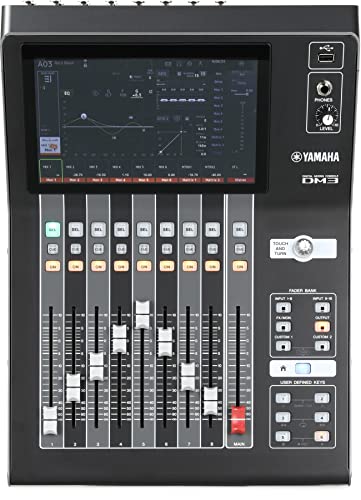
Yamaha DM3 Standard 22 Channel Ultracompact Digital Mixing Console
The DM3 Standard pairs 22 channels at a 96kHz sample rate with a 9-inch touch screen.
Why #2: No single top figure here; its WiseScore comes from its overall specs plus Amazon sales data.
- Channels
- 22 ch
- Warranty
- 1 year
Good fit if
- You mix 22 channels with a 9-inch touch screen
- You want a 96kHz sample rate and 18x18 USB recording
Look elsewhere if
- You need the 16 MIDAS preamps of the Behringer XR18
- You want the built-in Tri-mode Wi-Fi router of the XR18
The Yamaha DM3 Standard is a 22-channel ultracompact digital mixing console with a 96kHz sample rate. Its 22 channels break down as 16 mono, 1 stereo, and 2 stereo FX returns, with 6 mono or 3 stereo mixes, 2 matrixes, and 1 stereo bus. Sixteen professional Yamaha preamps cover 12 XLR inputs and 4 combo jacks, and 8 analog outputs use XLR connectors. The 9-inch touch screen sits on the console itself. The 18x18 USB audio interface handles playback and recording, and a separate 2x2 USB recorder is included. The console carries a 1 year manufacturer warranty, and its part number is DM3S.
Behringer FLOW 8 8-Input Digital Mixer
The FLOW 8 combines Bluetooth app control, 60 mm channel faders, and two Midas preamps.
Why #3: No single top figure here; its WiseScore comes from its overall specs plus Amazon sales data.
- Bluetooth
- Yes
- Wi-Fi or app control
- Yes
Good fit if
- You mix 8 inputs with Bluetooth remote control from a phone
- You want 60 mm channel faders and two Midas preamps
Look elsewhere if
- You need the 18 channels of the Behringer XR18
- You need the 22 channels of the Yamaha DM3 Standard
The Behringer FLOW 8 is an 8-input digital mixer with Bluetooth audio and app control. The FLOW App gives Bluetooth remote control from iOS or Android mobile phones or tablets, and the mixer itself carries 60 mm channel faders with a master rotary control and LED collar. EZ-Gain analyzes the signals in your application and automatically sets the gain for optimum headroom. Two Midas microphone preamps carry 48 V phantom power and programmable gain. The unit measures 6.5 x 9.7 x 1.1 inches, and its part number is P0DNM with model FLOW 8. Two FX processors and a USB and audio interface are included.
Allen & Heath CQ-18T Digital Mixer
The CQ-18T pairs a 7-inch touchscreen with built-in Wi-Fi, Bluetooth, and 4 FX engines.
Why #4: No single top figure here; its WiseScore comes from its overall specs plus Amazon sales data.
- Bluetooth
- Yes
- Wi-Fi or app control
- Yes
- Warranty
- 1 year
Good fit if
- You mix 16 mic or line inputs with a 7-inch touchscreen
- You want 24x22 USB and SD record and playback
Look elsewhere if
- You need the 18 channels of the Behringer XR18
- You want the 9-inch touch screen of the Yamaha DM3 Standard
The Allen & Heath CQ-18T is a digital mixer with a 7-inch capacitive touchscreen, Wi-Fi, and Bluetooth connectivity. It takes 16 mic or line inputs, 8 of which are combi, plus a stereo line input. Built-in 2.4GHz and 5GHz Wi-Fi with auto channel works alongside a stereo Bluetooth input. Recording runs through the 24x22 USB interface and 24x22 SD record and playback. The touchscreen works with an associated rotary control, 3 custom SoftKeys, and 3 custom SoftRotaries. Four FX engines are built in, and the mixer carries a 1 year warranty.
Worth the splurge, and what you can skip
Worth the splurge
- 22 channels at 96kHz. The Yamaha DM3 Standard is the pick with 22 channels at a 96kHz sample rate, so choose it when your sessions need that channel count and sample rate.
- A 24x22 USB interface. The Allen & Heath CQ-18T is the pick with a 24x22 USB interface and 24x22 SD record and playback, so choose it when your recording needs that many USB channels.
Fine to skip
- A built-in touch screen. If tablet or app control covers your sessions, the Behringer X AIR XR18 runs from an iPad or Android tablet and the Behringer FLOW 8 runs from the FLOW App, so a built-in screen adds hardware you would not use.
- Four FX engines. If your sessions need two FX processors, the Behringer FLOW 8 has two FX processors, so the four FX engines of the CQ-18T add engines you would not use.
Deciding factors for digital mixers
Channel count and buses
The Behringer X AIR XR18 gives 18 channels and 12 buses, while the Yamaha DM3 Standard gives 22 channels with 6 mono or 3 stereo mixes, 2 matrixes, and 1 stereo bus. The Allen & Heath CQ-18T takes 16 mic or line inputs, 8 of which are combi, plus a stereo line input. The Behringer FLOW 8 is an 8-input mixer. Count the sources you connect at once: microphones, instruments, and stereo sources all use channels. A mixer with more channels than sources leaves room for a guest microphone or an extra instrument. The Yamaha DM3 Standard breaks its 22 channels into 16 mono, 1 stereo, and 2 stereo FX returns.
Control surfaces and remote control
The Behringer X AIR XR18 runs from an iPad or Android tablet over a built-in Tri-mode Wi-Fi router, so no external router is needed for direct operation. The Yamaha DM3 Standard puts control on its 9-inch touch screen, and the Allen & Heath CQ-18T uses a 7-inch capacitive touchscreen with an associated rotary control, 3 custom SoftKeys, and 3 custom SoftRotaries. The Behringer FLOW 8 mixes the two approaches: 60 mm channel faders and a master rotary control with LED collar sit on the unit, while the FLOW App gives Bluetooth remote control from iOS or Android phones or tablets. Pick the surface you will reach for during a session: a tablet, a 9-inch touch screen, a 7-inch touchscreen, or 60 mm faders.
USB interfaces and recording
The Behringer X AIR XR18 records through an 18 x 18 channel, bidirectional USB interface for direct recording on an iPad. The Yamaha DM3 Standard matches that with an 18x18 USB audio interface for playback and recording, plus a 2x2 USB recorder. The Allen & Heath CQ-18T steps up the channel count with a 24x22 USB interface and 24x22 SD record and playback. The Behringer FLOW 8 carries a USB and audio interface. Decide how many tracks you record at once, then match that number to the interface: 18 x 18 channels, an 18x18 USB interface, or a 24x22 USB interface.
FAQ about digital mixers
How many channels do these digital mixers have?
The Behringer X AIR XR18 has 18 channels and 12 buses. The Yamaha DM3 Standard has 22 channels. The Behringer FLOW 8 is an 8-input mixer, and the Allen & Heath CQ-18T takes 16 mic or line inputs plus a stereo line input.
Which of these mixers have Bluetooth or Wi-Fi control?
The Behringer FLOW 8 has Bluetooth audio and app control through the FLOW App, and the Allen & Heath CQ-18T has built-in 2.4GHz and 5GHz Wi-Fi with auto channel plus a stereo Bluetooth input. The Behringer X AIR XR18 has a built-in Tri-mode Wi-Fi router for direct operation.
What USB recording options do these mixers offer?
The Behringer X AIR XR18 has an 18 x 18 channel, bidirectional USB interface for direct recording on an iPad. The Yamaha DM3 Standard has an 18x18 USB audio interface and a 2x2 USB recorder. The Allen & Heath CQ-18T has a 24x22 USB interface and 24x22 SD record and playback.
Bottom line
Keep comparing
More audio & music guides, ranked with the same WiseScore method.

Written by Nathan Reeve, WiseSplurge editor
Specs come from each maker's Amazon listing and were last checked on November 29, 2026. Each WiseScore (out of 10) blends those specs with Amazon sales data. We compare published figures rather than testing products in person.