Home/Tools & Workshop/Log Splitters
Log Splitters
Our main log splitters guide is pinned first. The other 9 narrow the list to a specific need.

Best Log Splitter (2026)
Top pick: SuperHandy Log Splitter

Best Gas Wood Splitter (2026)
Top pick: BILT HARD 40-Ton Gas Powered Log Splitter

Best Homemade Log Splitters (2026)
Top pick: BILT HARD 14 Ton Electric Log Splitter

Best Electric Log Splitter Under $500 (2026)
Top pick: PPOLB 7 Ton Electric Wood Splitter

Best 20 Ton Log Splitter (2026)
Top pick: Ezasin Gas Log Splitter 20 Ton
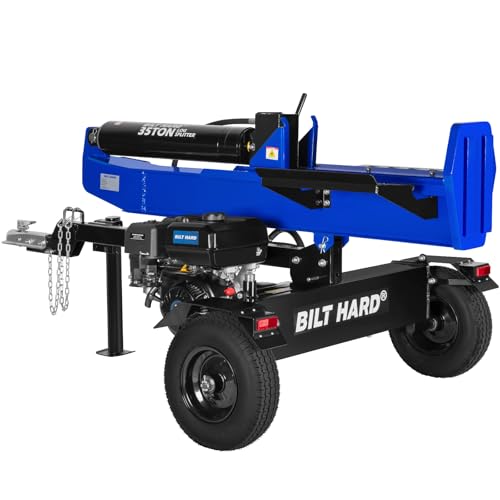
Best Skid Steer Log Splitter (2026)
Top pick: BILT HARD 35-Ton Horizontal/Vertical Gas Powered Hydraulic

Best Gas Log Splitter Under $1,000 (2026)
Top pick: BILT HARD 18-Ton Gas Log Splitter

Best Log Splitter Under $1,500 (2026)
Top pick: Maxsa Innovations 12 Ton Hydraulic Log Splitter

Best Log Splitter Under $500 (2026)
Top pick: GarveeTech 12 T Hydraulic Log Splitter
Best Portable Log Splitter (2026)
Top pick: SuperHandy Log Splitter
How to choose a log splitter
Log splitters in this group differ in how you drive the ram, how much force they apply, and how large a log they take. Splitting force runs from 5 tons to 40 tons, and maximum log length runs from 18 inches to 24 inches. Gas engines, electric motors, and manual pumps each drive the hydraulics, weight runs from 88.2 lb to 135 lb, and the stated cycle times run from 4.75 seconds to 20 seconds.
Controls: pedal, two-hand, lever, or pump handles
The control is the part you touch on every log, so it shapes the work more than any other feature. A foot pedal drives the ROCKCUB: stepping on it powers the 3HP motor and leaves one hand free for the hydraulic lever. Electric models such as the PPOLB, the Jocisland, the BILT HARD 14 Ton, and the VEVOR use two-hand controls. On the DR Pilot 6TE, a lever does the job: load a log, push the lever, and watch it split. Manual models such as the GarveeTech, the LEISULIF, and the Maxsa use 37-inch handles, and the Maxsa pairs its handles with a two-speed hydraulic pump, so each split takes repeated pumping. Choose the motion you can repeat across a full pile, since the manual handles measure 37 inches.
Pump flow rate in gallons per minute
Gallons per minute, or GPM, states how much hydraulic fluid the pump moves in one minute. The Full Boar 20 Ton, the BILT HARD 18-Ton 7HP 209cc, and the SuperHandy 14 Ton each state a 10.5 GPM pump, while the BILT HARD 40-Ton, the BILT HARD 30-Ton, and the BILT HARD 35-Ton each state a 14 GPM system. At the high end, the 14 GPM figure appears on three BILT HARD gas models, at 30 tons, 35 tons, and 40 tons, each paired with a 2-stage gear pump. At the low end, the 10.5 GPM figure appears on a 20-ton gas model, an 18-ton gas model, and a 14-ton electric model. Read the flow figure beside the force figure: 10.5 GPM at the low end and 14 GPM at the high end.
Engine torque in foot-pounds
Torque states the turning force an engine delivers to the hydraulic pump. Two gas engines in this group state a torque figure. The BILT HARD 18-Ton 7HP 209cc runs a 7HP 209cc OHV engine producing 9.6 ft.-lb. of torque, and the BILT HARD 40-Ton runs a 389cc 13 HP engine producing 16.96 ft.-lb. of torque. The higher figure sits on the larger engine, and that engine pairs with 40 tons of splitting force against 18 tons on the smaller engine. Use torque as a check on engine size when two gas models look alike on displacement alone, and compare the stated figures directly: 9.6 ft.-lb. at the low end and 16.96 ft.-lb. at the high end.