ELAC vs Klipsch Subwoofers (2026)

We earn a commission when you buy through our links, at no extra cost to you. As an Amazon Associate I earn from qualifying purchases.
Quick answer
ELAC fits buyers who want a 10 in powered subwoofer with wired inputs for an AV receiver or stereo amp, while Klipsch fits buyers who want up to a 12 in driver or a wireless sub for a Flexus sound bar. ELAC power runs from 100 W to 200 W peak, and Klipsch power runs from 150 W to 300 W.
Specs side by side
| Spec | ELAC | Klipsch |
|---|---|---|
| Driver size | 10 in, 10 in, 10 in | 10 in, 12 in, 10 in |
| Total power | 200 W, 100 W, — | 300 W, 200 W, 150 W |
Each cell lists the figure for every pick on that side, in the order shown below.
The picks on each side
ELAC

- Driver size
- 10 in
- Total power
- 200 W

- Driver size
- 10 in
- Total power
- 100 W

Klipsch

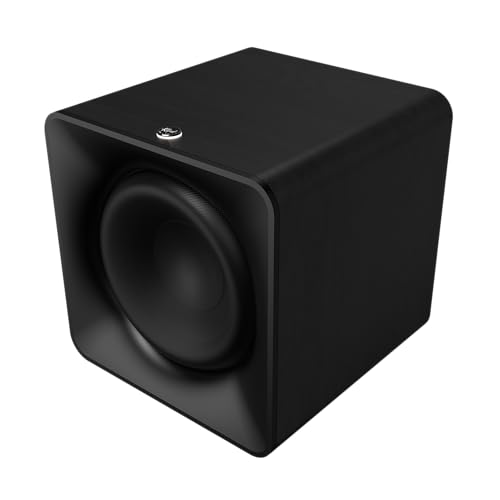
- Driver size
- 12 in
- Total power
- 200 W

- Driver size
- 10 in
- Total power
- 150 W
Key differences
Driver size options
All three ELAC models use a 10 in driver: the Debut 2.0 S10.2, the DS103 Debut 3.0, and the Debut 2.0 DS102.2. Klipsch offers a 10 in driver in the R-100SW and the Sub-100, and a larger 12 in driver in the Flexus SUB 200. The Flexus model is also the only one here documented as wireless, so the size step up on the Klipsch side comes with that wireless design.
Amplifier power figures
ELAC states 100 W for the DS103, with 100 W RMS and 200 W peak output, and a 200 W peak BASH amplifier for the S10.2 and DS102.2. Klipsch states 300 W total power for the R-100SW, 150 W for the Sub-100 with 300 W dynamic power, and 200 W for the Flexus SUB 200. The highest stated total here is the R-100SW at 300 W, while the DS103 carries the lowest stated total at 100 W.
Inputs and connection
The ELAC DS103 lists LFE, stereo, and high-level inputs plus high-level outputs, with an adjustable crossover from 50 Hz to 150 Hz, phase control, and auto on/off. The Klipsch R-100SW lists line level LFE RCA inputs with volume, low-pass, and phase control. The Sub-100 must be connected to an AV receiver, processor, or pre-amp, and the Flexus SUB 200 works exclusively with Klipsch Flexus CORE 100, CORE 200, and CORE 300 sound bars.
Which one to choose
Choose ELAC if
- You want a 10 in subwoofer with a sealed cabinet and a stated reach down to 31 Hz
- You need LFE, stereo, and high-level inputs plus high-level outputs on one subwoofer
- You want a braced MDF cabinet with a 200 W peak BASH amplifier
Choose Klipsch if
- You want the 12 in driver in the Flexus SUB 200 for a Flexus sound bar
- You want the highest stated total power here, 300 W in the R-100SW
- You want a front-firing spun-copper woofer with line level LFE RCA inputs
FAQ
Which side offers a 12 in subwoofer?
Klipsch does: the Flexus SUB 200 has a 12 in driver and 200 W total power. All three ELAC models here, the S10.2, DS103, and DS102.2, use a 10 in driver.
Can the Flexus SUB 200 connect to any receiver?
No. The Flexus SUB 200 works exclusively with Klipsch Flexus CORE 100, CORE 200, and CORE 300 sound bars. For a receiver connection, the R-100SW lists line level LFE RCA inputs, and the Sub-100 must connect to an AV receiver, processor, or pre-amp.
Which models list high-level inputs?
The ELAC DS103 has LFE, stereo, and high-level inputs plus high-level outputs. The Klipsch R-100SW has line level LFE RCA inputs, and the Sub-100 must be connected to an AV receiver, processor, or pre-amp.
Bottom line
Choose ELAC if you want a 10 in powered subwoofer with flexible wired inputs, such as the DS103 with LFE, stereo, and high-level inputs. Choose Klipsch if you want the 12 in wireless Flexus SUB 200 for a Flexus sound bar, or the 300 W R-100SW with line level LFE RCA inputs.
Keep comparing

Written by Nathan Reeve, WiseSplurge editor
Specs come from each maker's Amazon listing and were last checked on November 29, 2026. Each WiseScore (out of 10) blends those specs with Amazon sales data. We compare published figures rather than testing products in person.