Home/Cameras & Optics/Night Vision Goggles
Night Vision Goggles
Our main night vision goggles guide is pinned first. The other 6 narrow the list to a specific need.

Best Night Vision Goggles (2026)
Top pick: WOSPORTS 4K Night Vision Goggle

Best Night Vision Binoculars for Wildlife (2026)
Top pick: VOOPEAK 4K Night Vision Binoculars

Best Infrared Night Vision Binoculars (2026)
Top pick: WOSPORTS Night Vision Goggle

Best Night Vision Binoculars Under $200 (2026)
Top pick: WOSPORTS 4K Night Vision Googles
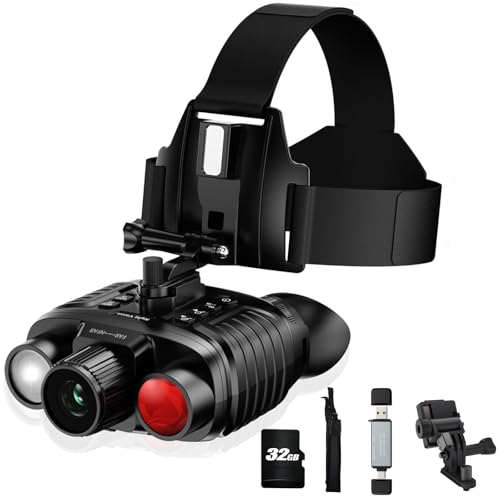
Best Hands Free Night Vision Goggles (2026)
Top pick: lovpo Night Vision Goggle

Best Night Vision Binoculars for Coyote Hunting (2026)
Top pick: WASOCA 4K Night Vision Goggle

Best Night Vision Goggles for Helmet (2026)
Top pick: PYKRONZ Head‑Mounted Night Vision Goggle
How to choose a night vision goggle
Night vision goggles in this category differ in how they fit your eyes, how wide a view they show, and how their sensors draw the picture. The diopter figures, the field of view in degrees, and the frame rate in fps are the 3 figures that shape what you actually see through the device. This page explains each figure with the numbers the category lists.
Eyesight adjustment and focus
Diopter adjustment sets the goggles to your eyesight, so a buyer who wears glasses for nearsightedness or farsightedness can use them without glasses. The stated diopter figures are ±8 diopters on the lovpo, up to -8.0 diopters on the GOYOJO, and 800-degree diopter adjustment on the ISHARE. Each eyepiece on the GOYOJO carries its own diopter adjustment ring. Manual focus is the other part of the same decision: the WIMIDING pairs 18X digital zoom with a manual focus function, and the ISHARE pairs its diopter adjustment with anti-shake manual focus. Check the diopter figure against your own glasses prescription, and check whether manual focus is stated.
Field of view in degrees
Field of view states how wide a scene the goggles show, in degrees. The figures in this category run from a 10° field of view on the Dsoon to a 54° wide angle field of view on the NIGHTFOX and a 70° wide-angle lens on the Nightfox Nova. A narrow view suits a distant subject in the center of the frame, while a wide view suits watching a broad area. The NIGHTFOX pairs its 54° view with 1x magnification for close surroundings, and the Nightfox Nova pairs its 70° lens with a 460ft infrared range. A 10° view shows a narrow slice of the scene, and a 70° view shows a broad sweep of it.
Sensor and frame rate
The sensor and the frame rate decide how the picture is drawn. The CIGMAN lists a starlight-grade CMOS sensor, and the Dsoon head-mounted goggle lists a Starlight CMOS sensor, for clear low-light viewing. The Nightfox Nova states a high-speed 60fps sensor for tracking fast-moving wildlife, and names 30fps as the standard rate. Frame rate is stated in fps: the Dsoon records 1920x1080 video at 30FPS, the GTMEDIA V6 records FHD P30 video, and the Nightfox Nova lists a high-speed 60fps sensor. The frame rate figures here run from 25fps on the Melicis to 60fps on the Nightfox Nova.