Best Solar Inverter with Charger (2026)

We earn a commission when you buy through our links, at no extra cost to you. As an Amazon Associate I earn from qualifying purchases.
Quick answer
Choose the SGPWATT SUNGOLDPOWER 10000W 48V Solar Inverter for a 48V setup that needs 10000W of rated output power and a maximum 200A battery charger. The ECO-WORTHY 5000W unit covers a smaller 48V setup with a 100A MPPT controller, while the Aninerel 4200W unit and the LiTime 3000W unit fit 24V battery banks. Each of the four pairs a pure sine wave inverter with a built-in solar charge controller.
Ranked at a glance
| # | Product | Rated power | Surge power | WiseScore | Link |
|---|---|---|---|---|---|
| 1 |  SGPWATT SUNGOLDPOWER 10000W 48V Solar InverterBest Overall | — | 20000 W | 9.2/10 | Check on Amazon → |
| 2 |  LiTime 3000W Solar Inverter ChargerSecond Pick | — | 9000 W | 9.1/10 | Check on Amazon → |
| 3 | 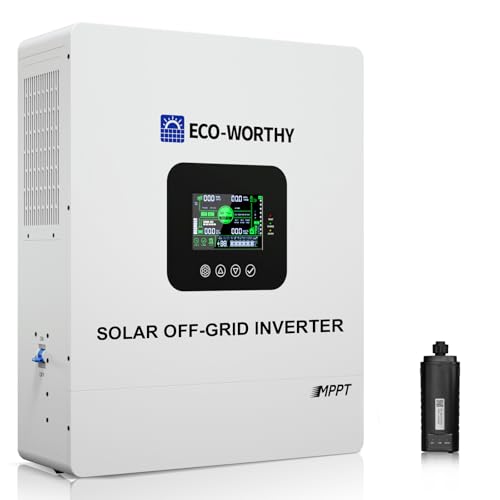 ECO-WORTHY UL1741 5000W 48V Solar Inverter ChargerAlso Consider | — | 10000 W | 9.0/10 | Check on Amazon → |
| 4 |  Aninerel 4200W Solar Hybrid InverterAlso Consider | — | 8400 W | 8.9/10 | Check on Amazon → |

The lineup, one by one
SGPWATT SUNGOLDPOWER 10000W 48V Solar Inverter
The 10000W rated output, 20000W peak power, two MPPT controllers and maximum 200A battery charger define this 48V inverter.
Why #1: Top figure in this lineup for surge power (20000 W). The rest of its WiseScore comes from Amazon sales data.
- Surge power
- 20000 W
- Warranty
- 2 year
Good fit if
- You run a 48V battery bank and need 10000W rated output
- You want two MPPT controllers and a 200A battery charger
Look elsewhere if
- You have a 24V battery bank
- You need a 120A MPPT controller
The SGPWATT combines a 10000W rated output with 20000W peak power and a maximum open circuit voltage of 500VDC. Its two MPPT solar controllers pair with a maximum 200A battery charger, and the AC output is settable to 120V/240V split phase or 120V single phase. Four charging modes cover Hybrid Charging, Utility Priority Charging, Solar Priority Charging and Only Solar Charging, with four output modes to match. A time-slot charging and discharging function lets you set charging and discharging periods around local peak and valley tariffs. The unit works with 48V AGM, Sealed, Gel, Flooded and Lithium batteries, plus a User Mode, and it supports battery-free operation. WiFi and BMS COMM come with CAN, USB and RS485 communication for SunGoldPower batteries. The warranty runs 2 years.
LiTime 3000W Solar Inverter Charger
The 3000W rated output, 60A MPPT controller and 50A AC battery charger define this 24V inverter for off-grid and RV use.
Why #2: No single top figure here; its WiseScore comes from its overall specs plus Amazon sales data.
- Surge power
- 9000 W
- Input voltage
- 24V
- Warranty
- 2 Years
Good fit if
- You run a 24V battery bank and need 3000W rated output
- You want UPS backup with a 60A MPPT controller
Look elsewhere if
- You need the 10000W rated output of the SGPWATT
- You need a 48V battery bank
The LiTime pairs a 3000W rated output with 9000W of surge power on a 24V input. Its 60A MPPT controller works with a 50A AC battery charger, and three charge modes cover MPPT First, MPPT and Grid, and Only MPPT. Three output modes cover MPPT First, Grid First and Inverter First, and an uninterruptible power supply keeps the output going when the grid drops. An LCD screen and LED indicators show battery, MPPT, AC output and AC input data. RS485 communication reports battery undervoltage, overvoltage and overcurrent. A lithium battery activation function wakes a lithium battery protected by BMS using commercial power, and adjustable speed fans cool the unit. The warranty runs 2 Years.
ECO-WORTHY UL1741 5000W 48V Solar Inverter Charger
The 5000W rated output, 100A MPPT controller and parallel support for up to six units define this 48V inverter.
Why #3: No single top figure here; its WiseScore comes from its overall specs plus Amazon sales data.
- Surge power
- 10000 W
- Input voltage
- 48V
Good fit if
- You run a 48V battery bank and need 5000W rated output
- You plan to parallel up to six units for 30 kW
Look elsewhere if
- You need more than 5000W from one unit
- You need a 24V input voltage
The ECO-WORTHY pairs a 5000W rated output with 10000W peak power and a rated output voltage of 120V. Its 100A MPPT controller works with a maximum 100A battery charger, split as 40A from AC and 100A from PV. The PV input voltage range runs 120-500 V DC. Three output modes cover mains priority, battery priority and PV priority, with an uninterruptible power supply, and four charging modes cover Only Solar, Mains Priority, Solar Priority and Mains and Solar Hybrid charging. A flexible time period for mains charging and discharging follows local mains conditions. Parallel support reaches up to six units for 30 kW, and more than two inverters in parallel output 120 V, 208 V or 240 V. An LCD display shows the system data.
Aninerel 4200W Solar Hybrid Inverter
The 4200W continuous output, 120A MPPT controller and 6200W photovoltaic array support define this 24V inverter.
Why #4: No single top figure here; its WiseScore comes from its overall specs plus Amazon sales data.
- Surge power
- 8400 W
- Input voltage
- 24V
- Warranty
- 2 Year
Good fit if
- You run a 24V lithium battery and need 4200W continuous output
- You want a 120A MPPT controller for a 6200W array
Look elsewhere if
- You need the 10000W rated output of the SGPWATT
- You need a 48V battery bank
The Aninerel delivers 4200W of continuous power with 8400W of surge power from a 24V DC input, outputting 110V AC as a pure sine wave. Its 120A MPPT controller supports photovoltaic arrays up to 6200W, with a maximum PV input voltage of 500V and an MPPT voltage range of 60–450V. Battery-free operation works when the PV input voltage reaches 130VDC or higher. RS485 communication supports LiFePO4 batteries with EQ balancing, and RS232 and dry contact interfaces join an optional WiFi remote monitoring module. A removable dust cover suits dusty settings, and the IP21 protection rating covers an operating temperature range of -10℃ to 50℃. The warranty runs 2 Year.
Worth the splurge, and what you can skip
Worth the splurge
- Battery-free operation. The SGPWATT and the Aninerel run without a battery, so choose one when your setup must keep working from PV input alone.
- An IP21 protection rating. The Aninerel carries an IP21 protection rating with a removable dust cover, so choose it when your setup sits in a dusty setting.
Fine to skip
- WiFi remote monitoring. If you check the system at the unit, the LCD screen of the LiTime and the LCD display of the ECO-WORTHY already show system data, so the WiFi module of the Aninerel adds a connection you would not use.
- Time-slot charging and discharging. If your charging follows one fixed pattern, the three charge modes of the LiTime already cover that pattern, so time-slot scheduling adds a setting you would not use.
Deciding factors for solar power inverters
Rated output power and surge power
Start with rated output power. The SGPWATT carries 10000W of rated output with 20000W of peak power, while the ECO-WORTHY carries 5000W of rated output with 10000W of peak power. The Aninerel carries 4200W of continuous power with 8400W of surge power, and the LiTime carries 3000W of rated output with 9000W of surge power. Keep the rated figure separate from the peak figure: the rated figure is the steady output, and the peak figure is the short surge the unit handles. The rated figures here run from 3000W on the LiTime to 10000W on the SGPWATT, and the peak figures run from 8400W on the Aninerel to 20000W on the SGPWATT.
Battery charger current and MPPT size
Charger current sets how fast the battery bank refills from AC and solar. The SGPWATT carries a maximum 200A battery charger with two MPPT controllers, while the ECO-WORTHY carries a maximum 100A battery charger with a 100A MPPT controller. The Aninerel carries a 120A MPPT controller, and the LiTime carries a 60A MPPT controller with a 50A AC battery charger. Larger MPPT current suits a larger array: the Aninerel supports photovoltaic arrays up to 6200W. Compare the charger current with the size of your battery bank and the MPPT current with the size of your array. The LiTime pairs a 60A MPPT controller with a 50A AC battery charger.
Input voltage and parallel operation
Input voltage must match your battery bank. The SGPWATT and the ECO-WORTHY take a 48V input, while the LiTime and the Aninerel take a 24V input. A 48V bank pairs with the 10000W SGPWATT or the 5000W ECO-WORTHY, and a 24V bank pairs with the 4200W Aninerel or the 3000W LiTime. Parallel operation adds capacity: the ECO-WORTHY parallels up to six units for 30 kW, and more than two inverters in parallel output 120 V, 208 V or 240 V. One inverter outputs 120V on its own, so a single unit suits a 120V setup while parallel units reach 240V. For parallel operation, the ECO-WORTHY runs up to six units for 30 kW.
FAQ about solar power inverters
What rated output power do these inverters have?
The SGPWATT has 10000W of rated output power, the ECO-WORTHY has 5000W, the Aninerel has 4200W of continuous power, and the LiTime has 3000W. Peak power runs 20000W on the SGPWATT, 10000W on the ECO-WORTHY, 8400W on the Aninerel and 9000W on the LiTime.
Which inverters here work with a 48V battery bank?
The SGPWATT and the ECO-WORTHY take a 48V input, so a 48V battery bank pairs with the 10000W SGPWATT or the 5000W ECO-WORTHY. The LiTime and the Aninerel take a 24V input, so a 24V battery bank pairs with the 3000W LiTime or the 4200W Aninerel.
How long is the warranty on these inverters?
The SGPWATT carries a 2 year warranty, the LiTime carries a 2 Years warranty, and the Aninerel carries a 2 Year warranty. Those terms each run two years, and the ECO-WORTHY warranty description is 1.
Bottom line
Keep comparing
More outdoors & camping guides, ranked with the same WiseScore method.

Written by Nathan Reeve, WiseSplurge editor
Specs come from each maker's Amazon listing and were last checked on November 29, 2026. Each WiseScore (out of 10) blends those specs with Amazon sales data. We compare published figures rather than testing products in person.